
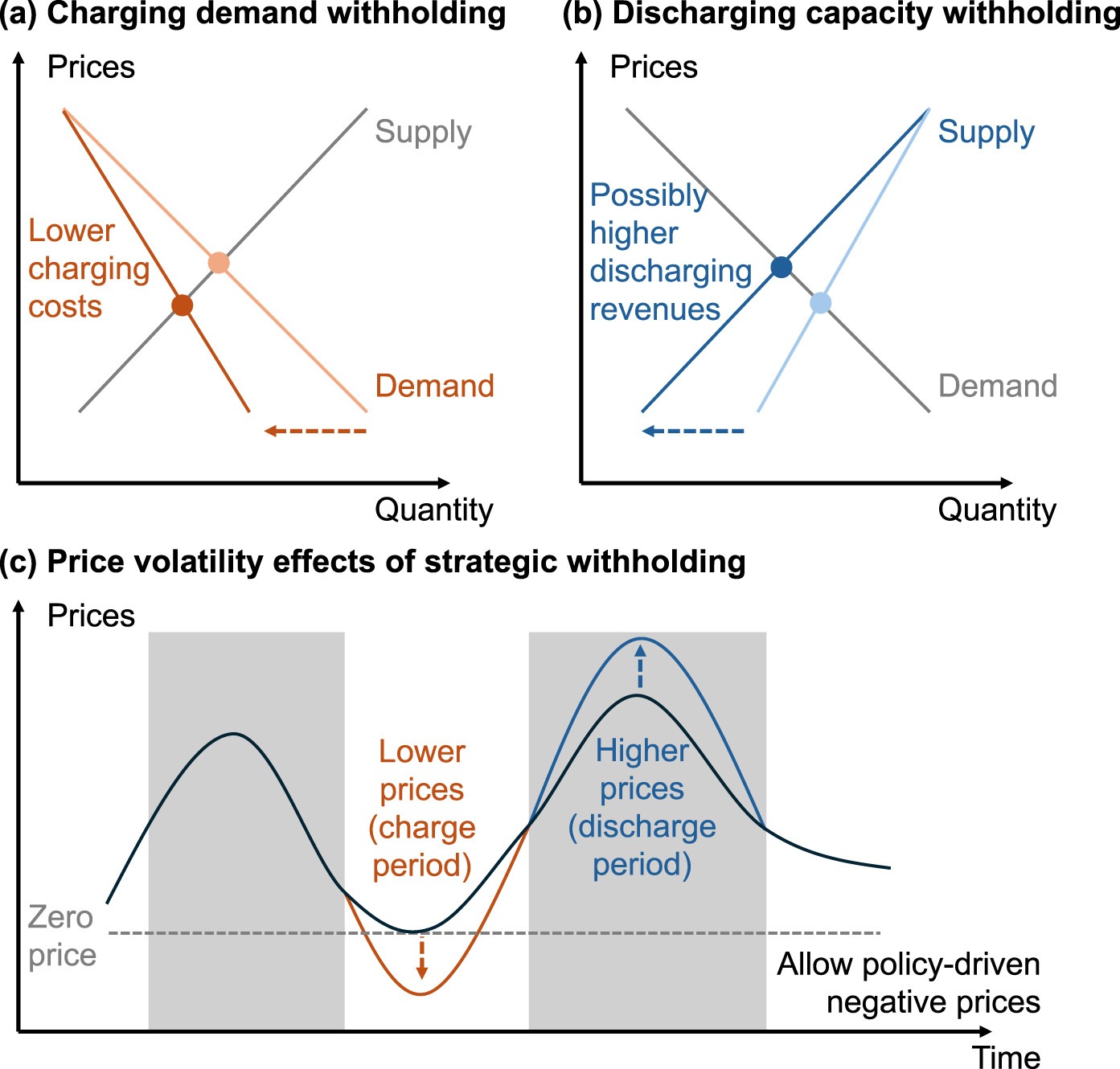
Negative electricity prices are becoming increasingly frequent in electricity markets due to incentive-driven bidding behaviors associated with renewable support schemes. This paper investigates the impact of price-making energy storage resources on market outcomes in the presence of renewable production incentives. We develop a bi-level model to examine three dimensions of strategic storage behavior: system costs and storage profits, electricity prices, and supplier surplus across generators. The upper level represents a storage profit maximization model, and the lower level represents the market operator’s economic dispatch problem. Using the Western Electricity Coordinating Council (WECC) system in the U.S. as a case study, we find that strategic storage behaviors increase storage arbitrage profits by 22%–126%, while raising system generation cost by less than 1% relative to a centrally controlled storage benchmark, when storage power capacity equals 14% of peak demand. In addition, negative electricity prices become more frequent due to storage’s capacity withholding mechanisms. Fossil-fueled generators experience surplus gains of up to 3% under strategic storage at high renewable penetration levels with negative price conditions. Future wholesale market designs should explicitly incorporate renewable policy incentive design and strategic storage behaviors, particularly given their joint effects on negative price formation and welfare distribution.
Recommended citation:
Zhang, Z., & Davidson, M. R. (2026). Negative electricity prices and strategic energy storage resources with high renewable penetration. Energy Economics, 164, 109654. https://doi.org/10.1016/j.eneco.2026.109654