
China’s power grid is facing several challenges to reliability. While demand continues to grow, new resources are coming online, which change previous patterns. China’s Southern Grid has a particularly unique situation, given its largest consuming province, Guangdong, is reliant on imported hydropower, which can face transmission constraints as well as low rainfall. Offshore wind has the potential to address some of these challenges, particularly during system stress periods of coincident high demand and low supply events.
In a collaborative study between the California-China Climate Institute at UC Berkeley and UC San Diego, we evaluate how large-scale offshore wind development will impact Southern Grid stability through 2060. We first assessed offshore wind resource potential and developed a power system planning model for 2030 and 2060 across three distinct scenarios. Finally, we evaluated system operational performance across ten historical weather years.
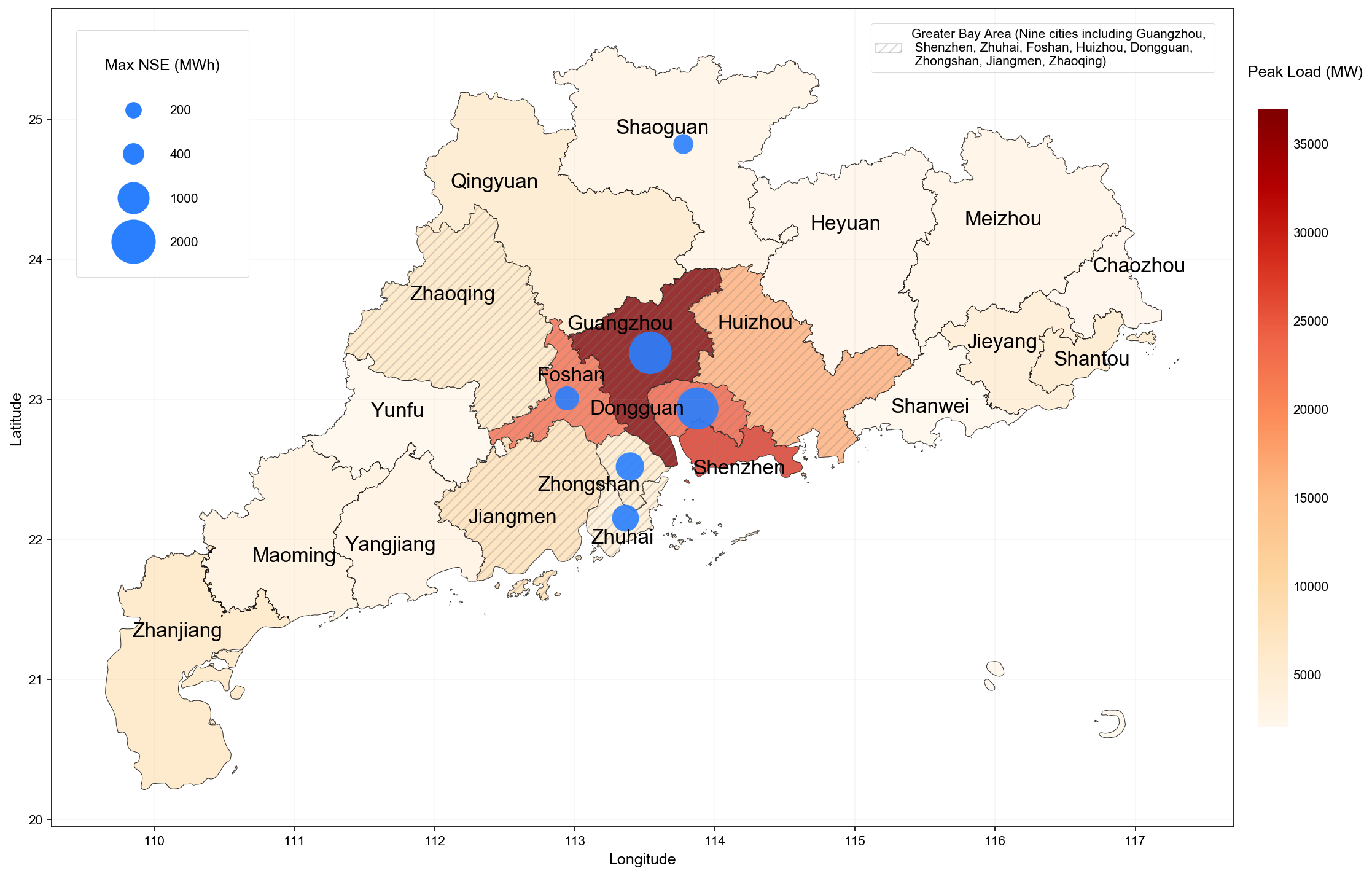
The findings indicate that offshore wind is deployed preferentially along Guangdong’s central coastline and northern Hainan, partially substituting for hydropower expansion in Guangxi. Adequacy outcomes vary based on planning reserve margins and specific stress conditions. Under high renewable penetration, system reliability becomes increasingly sensitive to hydropower availability and flexible dispatch. Notably, sub-provincial analysis reveals that nearly all power shortfalls are concentrated within the Greater Bay Area.
From a system planner’s perspective, these results suggest that embedding operational stress testing—focused on summer peaks, drought-driven low-hydro years, and constrained interprovincial transfers—is essential. Integrating these risks into adequacy planning will better align infrastructure decisions with real-world system vulnerabilities, while remaining compatible with existing institutional arrangements.
Detailed modeling and policy analysis can be found in the links below.
Executive Summary (Chinese and English)
Full Report (English)
Recommended citation:
Wei, M., Zhang, Z., Cui, X., Kahrl, F., & Davidson, M. R. (2026). Offshore Wind Power and Resource Adequacy in the China Southern Grid. California-China Climate Institute. Retrieved from https://www.law.berkeley.edu/wp-content/uploads/archive/2026/03/Offshore-wind-Report-Feb-2026.pdf