
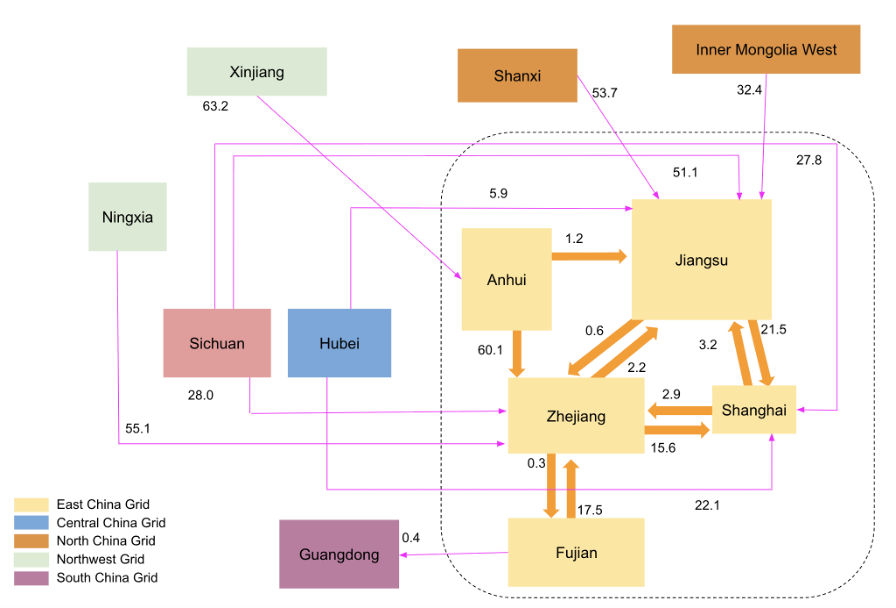
Figure: Yearly interprovincial and interregional transmission for ECG, 2022.
China’s East China Grid (ECG)—covering Shanghai, Jiangsu, Zhejiang, Anhui, and Fujian—sits at the center of one of the country’s most economically important and electricity-intensive regions. As demand continues to grow, renewable penetration increases, and extreme weather risks become more frequent, policymakers face a critical challenge: how to maintain resource adequacy and system reliability at reasonable cost while advancing decarbonization goals. This report examines that challenge by developing a transparent, model-based assessment of ECG resource adequacy for 2030 under different policy and stress scenarios.
The analysis shows that the ECG’s adequacy risks are shaped less by absolute capacity shortage alone than by institutional and operational constraints. The region depends heavily on interprovincial and interregional power imports, yet current medium- and long-term contract arrangements can limit the ability of power flows to respond flexibly during stress periods. At the same time, demand response, virtual power plants, and energy storage are expanding, but their integration into market-based operations remains incomplete. In this context, simply adding more coal capacity is neither the only option nor necessarily the most effective one.
Using a provincial-node unit commitment and economic dispatch model with hourly simulation over 12 high-stress summer weeks in 2030, this report evaluates how different combinations of weather stress, load growth, and policy interventions affect reliability outcomes. The findings indicate that unified economic dispatch across provinces and regions is the most powerful lever for improving resource adequacy in East China. Under coordinated dispatch, the ECG can maintain very high reliability even without additional coal buildout after 2025. Expanded storage and stronger demand response also play important supporting roles, especially under conditions where dispatch reform remains incomplete. By contrast, additional coal capacity may reduce shortages in some stressed cases, but it can also crowd out more flexible resources and increase renewable curtailment in several provinces.
Based on these results, the report argues that East China’s resource adequacy challenge should be addressed through institutional reform and more efficient use of flexible resources, rather than relying primarily on further coal expansion. It recommends establishing a transparent rolling resource adequacy assessment process, accelerating ECG-wide spot market integration and economic dispatch, reforming coal-specific compensation mechanisms, improving incentives for virtual power plants and demand response, and rationalizing the policy framework for battery storage. Together, these measures can support a more reliable, lower-cost, and lower-emissions power system in East China by 2030.
Recommended citation:
Davidson, M., Wei, M., Dupuy, M., Gao, C., Zhang, S., Shi, Z., Tang, W., & Wu, L. (2026). Resource adequacy assessment for the East China Grid: Policy interventions and contingent scenarios for 2030. Electricity Market Tracker. Available at: https://emtracker.org/research/resource-adequacy-assessment-for-the-east-china-grid-policy-interventions-and-contingent-scenarios-for-2030/.