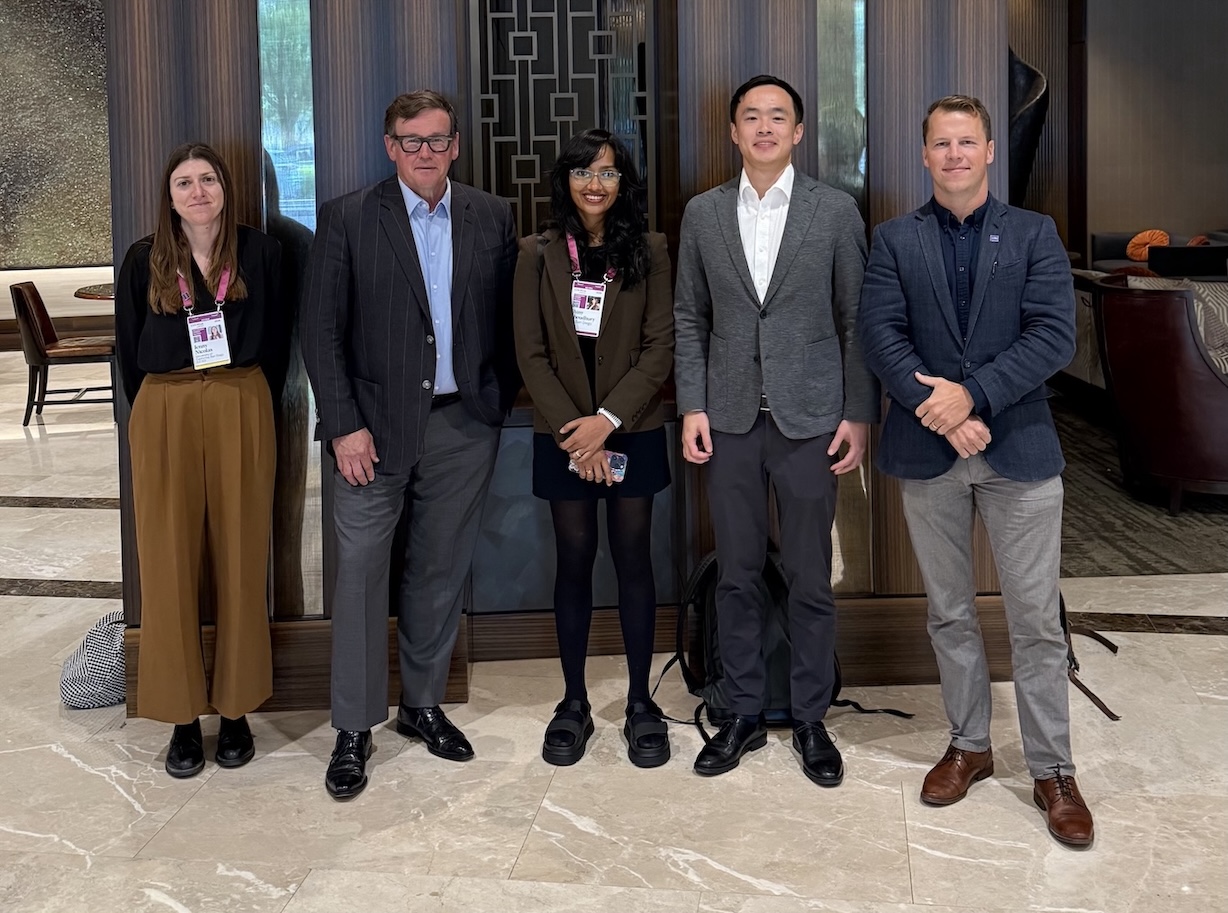
Pictured: Jenny Nicolas, Prof David Victor, Shiny Choudhury, Zhenhua Zhang and Zane Heather (SIO)
Power Lab members Shiny Choudhury, Jenny Nicolas, and Zhenhua Zhang attended CERAWeek in Houston from March 22nd to 26th as part of the inaugural NextGen Fellow cohort. They were selected from a UCSD-wide internal pool of Ph.D. candidates based on their advanced-stage research, academic excellence, and interest in the energy sector. They were joined by Prof. David Victor and Zane Heather of SIO.
CERAWeek is colloquially known as the “Energy Super Bowl.” It had over 11,000 attendees across 90 countries. Shiny, Jenny, and Zhenhua presented their research on SMRs, solar siting, and resource adequacy modeling at the Innovation Agora sessions.
Core to the theme of this year’s conference:
- While there was much buzz about newer technologies such as enhanced geothermal, Gen-IV nuclear, and nuclear fusion, there is concern around financing and escaping the valley of death. Specifically, once funding for FOAK pilot projects dries up, where can new technologies turn for mid-stage capital?
- Discussion of AI’s potential was far-reaching, extending well beyond the “AI Potential: Hype vs. Reality” panel in which Professor Victor was a panelist. The resounding message is that AI can be positive for the industry, supporting solutions to various energy transition challenges, such as easing strain on the interconnection queue. The key is for industry to get ahead of it—companies should leverage AI but not let it run their operations blindly. In parallel, the increase in energy demand from data centers will reshape the energy landscape.
- The oil and gas industry was well represented at CERAWeek, and the impact of the blockage at the Strait of Hormuz could not be ignored. This echoes the 1973 oil embargo and raises questions about what happens when countries rely on oil imports, how individuals are affected when filling their cars with gas, and the meaning of “energy dominance” and “energy independence” in an uncertain geopolitical era. There were also hopes that countries would finally prioritize the energy transition in the face of such vulnerabilities.
- In a time of political uncertainty and generational differences over the energy transition, media figure Van Jones and others on the closing panel discussed the importance of identifying shared priorities and forming coalitions.
In a panel featuring Arun Majumdar, Dean of the Stanford Doerr School of Sustainability, he asked: as academics, where is the “white space” to transform industry? Within the Power Lab, we left CERAWeek feeling inspired to continue locating and uncovering that white space.
As an annual energy-sector convention, CERAWeek has undergone significant thematic shifts over the past few years. This year, the spotlight on hydrogen has notably dimmed, replaced by a more pragmatic focus on the physical risks facing data center infrastructure and the need to bring generation capacity online faster.
Clean energy targets felt underemphasized. The silence is uncomfortable, making it difficult to gauge the industry’s true appetite for green premiums—such as the ~15% increase in LCOE required to pair gas plants with carbon capture systems.
The macro-investment landscape reveals contrasts. The world has seen up to $2.2 trillion in renewable energy investments, roughly double that of fossil fuels in 2025. Despite this, early-stage clean tech companies continue to struggle to raise capital for geothermal drilling, climate risk mitigation, gas turbine repurposing, and related efforts.
What remains promising is the shift in dialogue from “if” to “how.” Conversations are centered on how to do this better: driving down costs through innovation, such as high-efficiency perovskite solar cells. There is also a growing focus on go-to-market strategies over technical specifications. Whether it is ammonia for the shipping industry or cross-border carbon transfer, the industry is learning how to attract more capital: simplicity, revenue certainty, and operational reliability.
Power Lab members wonder what CERAWeek will cover next year. The integration of compute, energy, and infrastructure; the hunt for credibility in a highly chaotic world; and the continued expansion of AI. 2027 and beyond will be interesting to track.